



For Singaporeans, comparing chemical peels vs. laser resurfacing is not just about appearance, but about finding a treatment that fits real life, real budgets, and real expectations.
In the world of aesthetics, chemical peels are often chosen for surface-level concerns such as dull skin, mild pigmentation, and early texture changes, while laser resurfacing is often better suited to deeper acne scars, more visible sun damage, and concerns that need a stronger level of skin renewal.
In this article, you will see how these treatments differ in results, downtime, session count, and long-term value, so you can weigh the trade-offs more clearly before making a decision.
Let’s get into what really matters.
What is a Chemical Peel?
A chemical peel is a skin treatment that uses a chemical solution to lift off damaged surface skin, so fresher skin can replace it. People usually look into it for acne scars, post-acne marks, pigmentation, rough texture, enlarged pores, oily skin, and early fine lines.
The session itself is usually quite short, often around 30 to 45 minutes, though that can vary with the type and strength of the peel.
At Sozo Clinic, three commonly used peel types include:
- Glycolic acid: often used when skin looks dull, feels uneven, or is starting to show fine lines. It is usually seen as a gentler option.
- Salicylic acid: often used for oily or acne-prone skin because it can work through oil and help clear out pores. It is commonly chosen for blackheads, whiteheads, and breakouts.
- Trichloroacetic acid: a stronger peel often used for more obvious pigmentation, sun damage, and deeper textural change or lines.
Not every peel goes to the same depth, so the peeling, recovery, and level of improvement can differ quite a bit from one person to another.
What is Laser Resurfacing
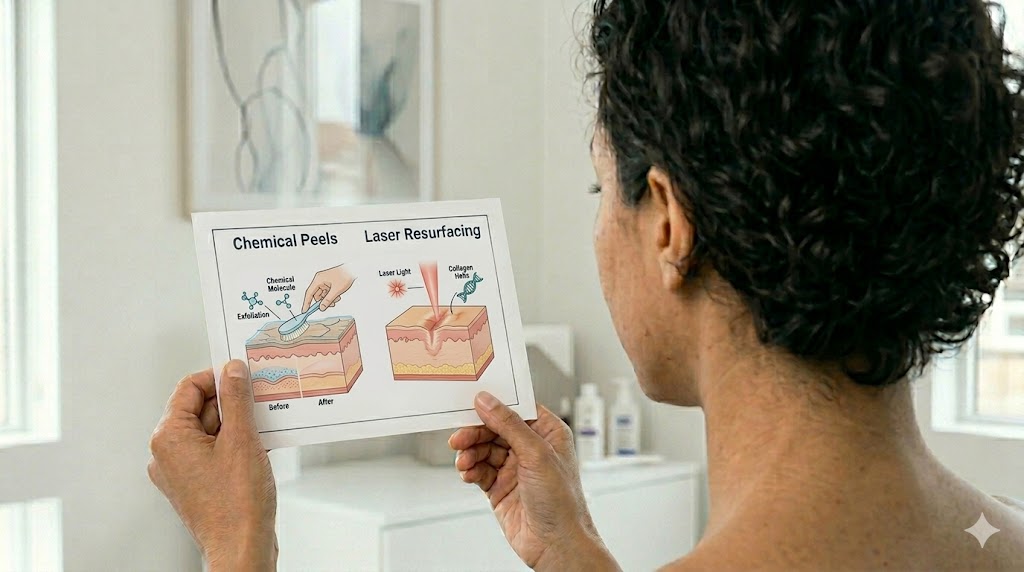
Laser resurfacing is a skin treatment that uses focused light energy to work on specific layers of the skin. When that light hits the target area, it turns into heat. That heat can remove damaged skin or trigger collagen remodelling, depending on the laser used. People usually look into it for acne scars, uneven texture, fine lines, wrinkles, and some pigmentation concerns.
Common types of laser resurfacing include:
- CO2 laser: often used for deeper resurfacing, acne scars, rough texture, and fine lines
- Erbium laser: often used for wrinkles and fine lines, with less heat spread to nearby skin and usually a shorter recovery
- Ablative lasers: remove the outer skin layers and usually come with longer downtime, often lasting days to weeks
- Non-ablative lasers: work beneath the surface without removing the top layer, so recovery is usually shorter, often hours to days
Because laser resurfacing is not just one treatment, the results and recovery can vary a lot depending on the device, the setting, and the skin concern being treated.
Chemical Peels Vs. Laser Resurfacing: 7 Key Differences
Now that you have a clearer picture of what chemical peels and laser resurfacing actually are, it’s time to look at the details that really shape the decision.
With that in mind, here are seven key differences that deserve a closer look.
1. How Each Treatment Works
- Chemical peels: the solution sits on the skin for a set time, then gets neutralised or removed. As the top layer sheds, fresher skin comes through. Glycolic acid is often used for dullness, salicylic acid for oily break-out-prone skin, and TCA for more stubborn pigmentation or rough texture.
- Laser resurfacing: the device sends light into the skin in a controlled pattern, and that light turns into heat. CO2 lasers are often used for deeper acne scars and more obvious textural damage, while erbium lasers are more often used for lines and wrinkles when a shorter recovery is preferred.
2. Skin Concerns Each Treatment Is Best Suited For
- Chemical peels: these are usually chosen for issues closer to the surface, like post-acne marks, melasma, sunspots, oily skin, clogged pores, rough patches, and fine lines. Glycolic acid is often used when skin looks dull, salicylic acid is common for break-out-prone skin, and TCA is used when pigmentation or texture looks more noticeable.
- Laser resurfacing: this is usually chosen when the problem runs deeper, like acne scars, rough uneven texture, deeper lines, and more obvious sun damage. CO2 lasers are often used for thicker scars and stronger resurfacing, while erbium lasers are more often used for lines and wrinkles when a lighter recovery is preferred.
3. Ideal Candidate
- Chemical peels: often suit people dealing with blackheads, whiteheads, oily skin, post-acne marks, uneven tone, rough patches, enlarged pores, and early fine lines. They tend to make more sense when the issue is mostly on the surface, not deeper down.
- Laser resurfacing: often suits people with indented acne scars, especially rolling and boxcar scars, along with rough texture, deeper lines, and visible sun damage. It usually makes more sense when the skin needs stronger resurfacing than a surface-based treatment can provide.
Scar type matters more than many patients expect, because indented scars such as rolling and boxcar scars usually reflect deeper structural change below the surface, which is why surface-led treatments may improve tone but still leave the skin looking uneven.
4. Downtime And Recovery
- Chemical peels: the session itself usually takes 30 to 45 minutes. After that, the skin can look red, feel tight, and start peeling over the next few days. Lighter peels usually mean less downtime, while deeper peels tend to take longer to settle.
- Laser resurfacing: recovery depends much more on the laser type. Non-ablative lasers usually have shorter downtime, often 1 to 3 days, while ablative lasers can mean a longer recovery of several days to a few weeks. Redness, swelling, and temporary pigment changes can show up during that period.
5. Results And Timeline Of Improvement
- Chemical peels: you usually do not walk out looking dramatically different. Once the peeling calms down, skin often starts to look clearer, smoother, and brighter. Things like post-acne marks, rough patches, and uneven tone usually need a few sessions.
- Laser resurfacing: the change can be more noticeable when the problem is deeper, like acne scars, rough texture, or lines. You may see some improvement once healing settles, but the skin often keeps improving over the next few weeks.
6. Number Of Sessions And Maintenance Needed
- Chemical peels: lighter peels usually work best as a short course rather than a one-off treatment. For post-acne marks, clogged pores, uneven tone, and rough texture, around 3 to 5 sessions is often a sensible guide. After that, some people still come back every few months for maintenance.
- Laser resurfacing: this often takes fewer sessions, especially when the main issue is deeper acne scars, rough texture, or lines. Some people get the level of improvement they want in 1 to 3 sessions. The exact number still depends on the laser used and how much resurfacing the skin really needs.
7. Total Cost Over Time
- Chemical peels: at Sozo Clinic, a chemical peel session starts at around $300. If you are doing a course of 3 to 5 sessions, the rough total comes to about $900 to $1,500 before any maintenance sessions later on.
- Laser resurfacing: at Sozo Clinic, skin resurfacing treatments such as Fractional CO2 laser range from about $250 to $1,000 per session. If you need 1 to 3 sessions, the rough total can land around $250 to $3,000.
When Chemical Peels Offer Better Value
Chemical peels may be more suitable when the concern sits closer to the surface rather than deeper in the skin. This can include oily skin, clogged pores, blackheads, whiteheads, post-acne marks, mild pigmentation, rough texture, enlarged pores, and early fine lines, depending on the peel selected and the skin’s response.
At Sozo Clinic, a session costs around $300, making the upfront cost easier for many people to manage. The treatment also usually takes 30 to 45 minutes, which suits people who want something simpler and less disruptive. In plain terms, peels make more sense when you need gradual surface improvement, not stronger resurfacing for deeper scars or wrinkles.
When Laser Resurfacing Offers Better Value
Laser resurfacing may be considered when the problem sits deeper in the skin and a surface-led treatment may not be enough. This can include indented acne scars, rough, uneven texture, deeper fine lines, wrinkles, and more visible sun damage, although suitability depends on the individual’s skin findings, goals, and tolerance for downtime.
CO2 laser, for example, is commonly used for deeper acne scars, texture changes, and fine lines. A study on fractional CO2 laser found that treatment could be done over as many as 6 sessions, spaced 1 month apart, and the results were encouraging: 35% of patients had their scars clear completely, while 40% saw their scars improve by more than half.
At Sozo Clinic, skin resurfacing treatments such as Fractional CO2 laser range from about $250 to $1,000 per session. In simple terms, lasers tend to make more sense when stronger resurfacing and deeper collagen remodelling are part of the goal.
Chemical Peel vs Laser Resurfacing – Which is Right for Me?

If your main concern is oily skin, blackheads, whiteheads, post-acne marks, mild pigmentation, rough texture, or early fine lines, a chemical peel often makes more sense.
It is also the easier starting point if you want a shorter 30 to 45 minute treatment and a lower entry cost, with sessions starting from around $300.
But if you are dealing with indented acne scars, rough uneven texture, deeper lines, wrinkles, or more obvious sun damage, laser resurfacing may be the better fit, although it can be a bit more costly.
This kind of decision is usually clearer with a doctor-led assessment, which is where Dr. Justin Boey’s background becomes relevant. He holds an MBBS from the National University of Singapore, has Ministry of Health-approved Certificates of Competence in Aesthetics, and focuses his practice entirely on non-surgical aesthetics, including acne scars.
That depth of experience helps him recommend the most suitable treatment approach based on your skin concerns, treatment goals, and the level of resurfacing your skin actually needs.
Can Combining Both Improve Value Over Time?
Yes. The value comes from using the right treatment at the right stage, instead of overpaying for one treatment to handle everything.
For example, a chemical peel may be used first to manage oiliness, clogged pores, post-acne marks, or uneven tone, while laser resurfacing may be added later if deeper acne scars or rough texture still remain.
This can make more sense over time because it helps avoid jumping straight into a stronger, more expensive treatment when part of the problem is still superficial. It can also help avoid repeating lighter treatments too many times when the deeper issue clearly needs more targeted resurfacing.
Combination treatment is not about doing more because value often comes from sequencing treatments properly, using surface-focused options for pigment or congestion first and reserving deeper resurfacing for scarring or texture that remains.
Conclusion
Choosing the right resurfacing treatment is less about finding the cheapest option and more about matching the treatment to your skin concern, recovery tolerance, and long-term goals.
When comparing chemical peels vs. laser resurfacing, the real difference usually comes down to how deep the issue goes, how much downtime you can manage, and how many sessions you may need.
If the concern is mostly on the surface, a peel may give you better value, but if the problem sits deeper, laser resurfacing may be the more sensible investment.
Book a consultation with Sozo Aesthetic Clinic to get a clearer, more personalised plan for your skin before you spend on the wrong treatment.